
June 7, 2026 · 8 min read
Can I use a diffuser if I have cats or dogs
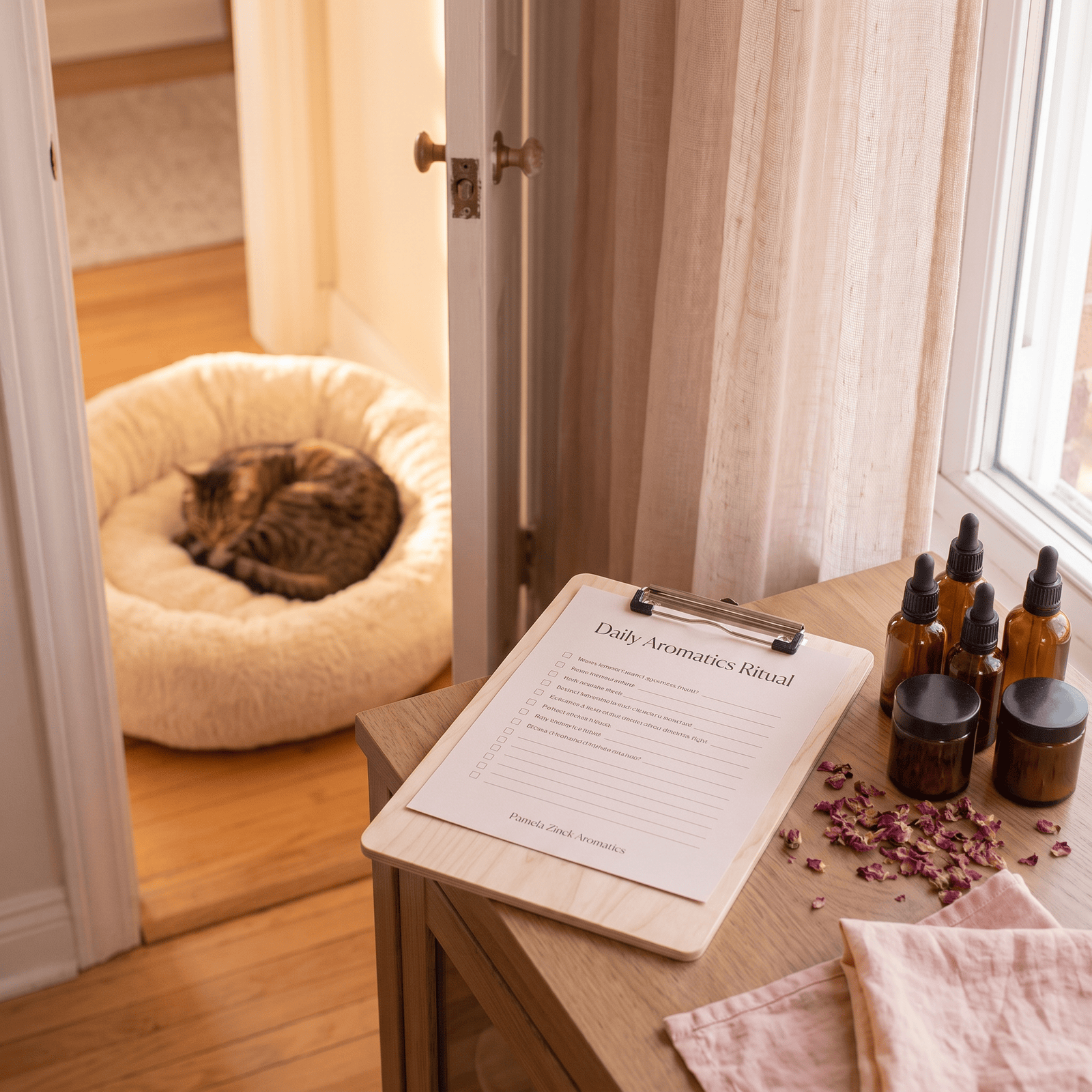
The question I get most often is which oils are safe around cats. The more useful question is how the room is set up, because a well ventilated room with a short run time is safer than a sealed room with a carefully chosen blend. Setup first, botanical list second. That ordering surprises people and it is the single most useful thing in this piece.
Cats and dogs are not the same problem and should not be treated as one. Cats lack sufficient glucuronyl transferase, a liver enzyme that handles the conjugation and clearance of phenols and certain terpenes. Compounds that a dog or a human clears without difficulty can accumulate in a cat. Dogs metabolise more like we do, but they have a vastly more sensitive nose and considerably less choice about the room they are in, so a concentration that reads as pleasant to you can be genuinely overwhelming to them.
Birds are a separate and firmer case. Their respiratory systems are extraordinarily efficient and correspondingly vulnerable to airborne irritants. If there is a bird in the home, the honest recommendation is not to diffuse in the shared airspace at all. This is the same reason that non stick cookware fumes are dangerous to birds and unremarkable to us.
For cats, the materials worth avoiding are the phenol heavy and monoterpene heavy ones. Tea tree stands out as the one causing the most documented harm, usually from topical application rather than diffusing, and it should not be applied to a cat under any circumstances. Also worth keeping out of a shared room: oregano, thyme, clove, cinnamon bark, wintergreen, pine, and the citrus oils, particularly in concentrated form. Peppermint and eucalyptus are strong enough that I would skip them in a small flat with a cat.
For dogs, the list is shorter but tea tree, pennyroyal, wintergreen, and pine are still ones I would leave out. Undiluted application to fur or skin is the real hazard, and dogs will lick whatever is put on them, so anything topical becomes an ingestion question rather than a skin one.
Now the setup, which is where the actual safety lives. Run the diffuser for twenty to thirty minutes, not all afternoon. Leave a door open so an animal can walk away, and let them. Animals are quite good at leaving a room they dislike, provided they are allowed to. A cat shut into a scented room has no way to register an objection except by being unwell later.
Keep the diffuser elevated and out of reach. Off the floor, away from food and water bowls, away from bedding, away from litter trays. Two reasons. Concentrated mist settles, and a diffuser knocked off a low table means undiluted oil on a floor that a cat will walk through and then groom off its paws. That grooming route is how a spill becomes an ingestion.
Choose the room deliberately. Diffuse in a space the animal does not sleep in and does not have to pass through constantly. A home office with a door works well. A hallway or a small kitchen works badly. And ventilate afterwards rather than only during, because the residual concentration after a session is what an animal returning to the room encounters.
Watch for the signs that something is wrong, because animals do not complain in words. In cats: drooling, pawing at the face or mouth, vomiting, unsteadiness, lethargy, tremors, difficulty breathing, or a sudden change in behaviour. In dogs: excessive drooling, watery eyes, nose rubbing, coughing, wheezing, or reluctance to enter a room they normally use. Any of those means switch the diffuser off, open the windows, move the animal to fresh air, and call your vet. If there has been skin contact, wash the area with a mild dish soap, which cuts oil better than pet shampoo.
Passive diffusion methods are not automatically safer. A reed diffuser or an oil warmer with a tipping hazard sitting on a side table is arguably worse than an ultrasonic unit on a high shelf, because it holds a reservoir of concentrated liquid at cat height indefinitely. Plug in warmers have the same problem at floor level. If a spill is possible, assume it will eventually happen.
There are genuinely good alternatives if the risk calculus does not sit well with you, and it does not need to. A personal inhaler, which is a small tube you hold to your own nose, delivers the scent to exactly one animal in the house and that animal is you. A roller on your own wrists does the same. Simmering herbs on the stove, or simply opening a window and moving air, changes how a room feels more than people credit.
One last note on smaller animals. Rabbits, guinea pigs, rats, hamsters, and ferrets all have small bodies, fast respiration, and no way to leave an enclosure. Do not diffuse in a room where a caged animal lives, because the entire premise of letting an animal walk away depends on it being able to walk away.
The short version to keep in your head: short sessions, open door, elevated unit, ventilate after, skip the phenol heavy oils in a cat home, and watch the animal rather than the clock. Done that way, most households with a dog or a cat can use a diffuser thoughtfully. Done the other way, no botanical list will save you.