
July 19, 2026 · 8 min read
Best essential oils for stress and sleep, for beginners
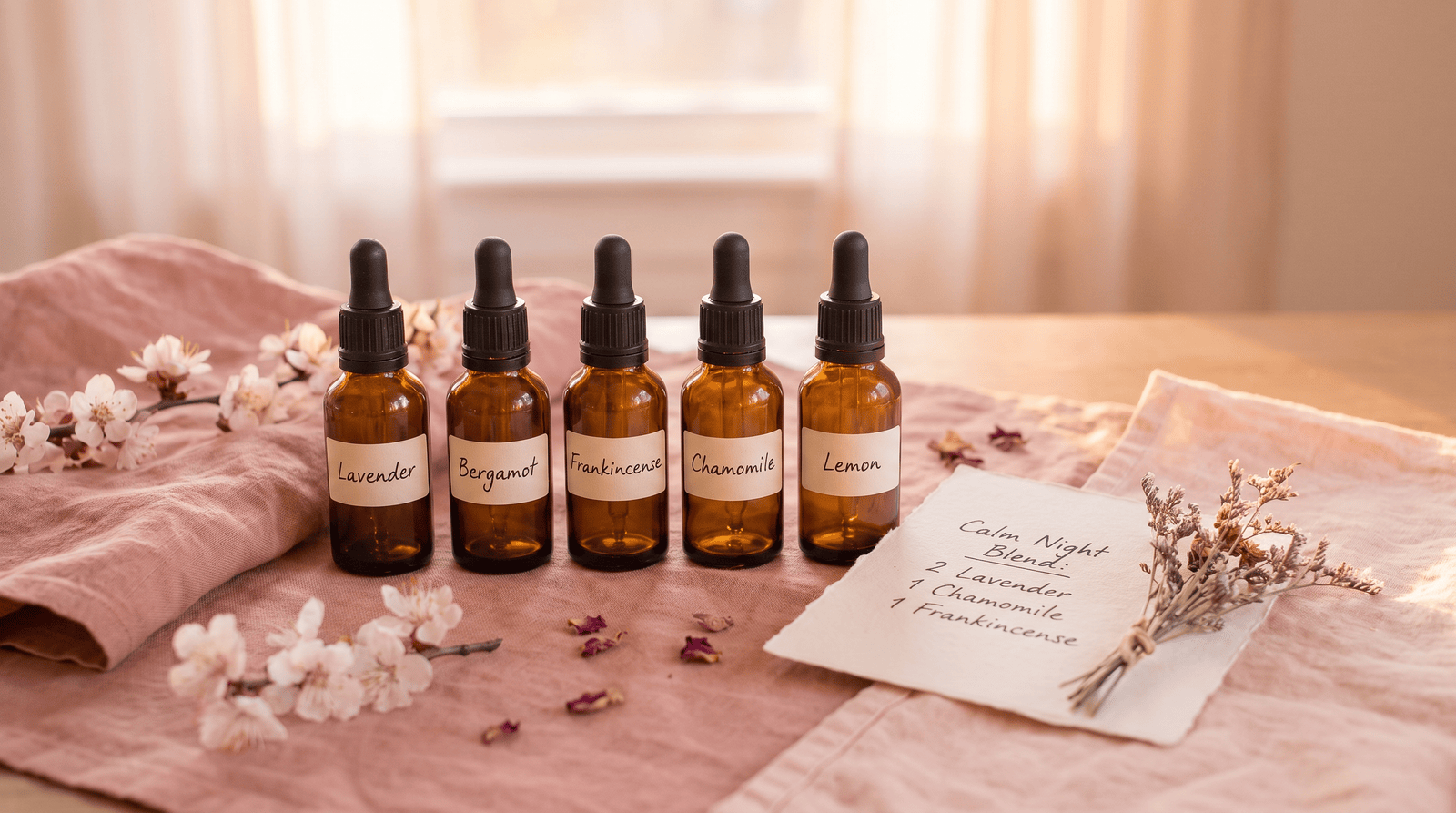
Starter lists tend to run to twenty bottles, which is how a beginner ends up with a drawer of things they never opened twice. A working starter kit is four or five botanicals that cover most of what a stressed, under slept person actually needs. Everything else can wait until you know what you reach for.
Lavender is the obvious first entry and it earns the place, though not for the reason it is usually sold. It is not a sedative. It is a softener. Used in the evening at a low dilution it takes the edge off a busy head and it plays well with almost everything else, which makes it forgiving while you are learning to blend. A common mistake is using too much of it, at which point it stops reading as restful and starts reading as a hotel corridor. Restraint is the whole trick with lavender.
Roman chamomile is the one I would add second for sleep specifically. It is quieter than lavender, slightly fruity, and it suits people who find lavender cloying. It is expensive, which is worth knowing before you order, and it is usually best in small proportions inside a blend rather than used alone. Two or three drops inside a 10 ml roller alongside a base note will do more than a bottle used generously.
Cedarwood is the workhorse of an evening blend and it is inexpensive, which is a rare combination. It is a base note, meaning it lingers and anchors the lighter material above it. Without a base note, a blend evaporates within twenty minutes and the ritual feels like it ended too early. Atlas cedarwood and Virginian cedarwood are different plants with different profiles, so read the botanical name rather than the marketing name on the label.
Bergamot is the daytime entry. It is bright without being sharp and it suits the mid afternoon far better than any citrus that reads as purely energetic. The important caveat is phototoxicity. Standard bergamot can cause a burn reaction on skin exposed to sunlight for up to twelve hours after application. Buy the bergapten free version, usually labelled FCF, if you intend to use it on skin during the day, or keep ordinary bergamot for the diffuser only.
Sweet marjoram is the fifth and the least glamorous. It smells herbal and slightly warm and almost nobody puts it on a wish list, but it is consistently the one that makes an evening blend feel complete. It sits between the florals and the woods and it stops a sleep blend from smelling like a candle.
That is the list. Lavender, Roman chamomile, cedarwood, bergamot, sweet marjoram. Five bottles, a carrier oil, a handful of 10 ml rollers, and you can build almost every calm or sleep blend a beginner needs for a year.
For carrier oil, fractionated coconut is the practical default. It stays liquid, it does not go rancid quickly, it has almost no scent of its own, and it does not stain fabric badly. Jojoba is lovely and lasts even longer on the shelf but costs more. Sweet almond is fine and cheap, though it is worth avoiding around anyone with a nut allergy in the household, including guests.
A first evening roller, if you want one to copy: in a 10 ml roller, four drops lavender, three drops cedarwood, two drops sweet marjoram, one drop Roman chamomile, topped with fractionated coconut oil. That lands around two percent, which is a reasonable adult evening strength. Roll on the wrists and the base of the neck about twenty minutes before bed, then take three slow breaths from the wrists rather than sniffing the bottle.
A first diffuser blend, similarly: three drops bergamot and two drops cedarwood in a small room, run for twenty five minutes in the late afternoon. It reads as clean air rather than perfume, which is what you want in a room you are trying to work or read in.
What to avoid buying early. Anything sold as a proprietary blend with an undisclosed ingredient list, because you cannot troubleshoot a formula you cannot see. Anything described as therapeutic grade, which is a marketing phrase with no governing body behind it. And any single oil that costs a great deal and does one narrow thing, at least until the basics are habitual.
How to judge quality without a laboratory. Look for the Latin botanical name, the country of origin, the extraction method, and a batch number on the bottle. Suppliers who publish gas chromatography reports for their batches are telling you they expect to be checked, which is a good sign. Price that is dramatically below the market for a given botanical usually means dilution or adulteration rather than a bargain.
Store everything in dark glass, away from heat and light, with the caps tight. Citrus oils oxidise fastest and are the most likely to cause skin irritation once they have turned, so date the bottle when you open it and treat citrus as a twelve month material rather than an indefinite one. Woods and resins last considerably longer and some genuinely improve.
The point of a short list is that it lets you learn what things do. Five botanicals used repeatedly will teach you more about blending than thirty used once each, and the drawer stays usable rather than becoming an archive.